

Cybersecurity
HIPAA Policies Are Not Enough: What Evidence Healthcare Organizations Need to Prove Readiness
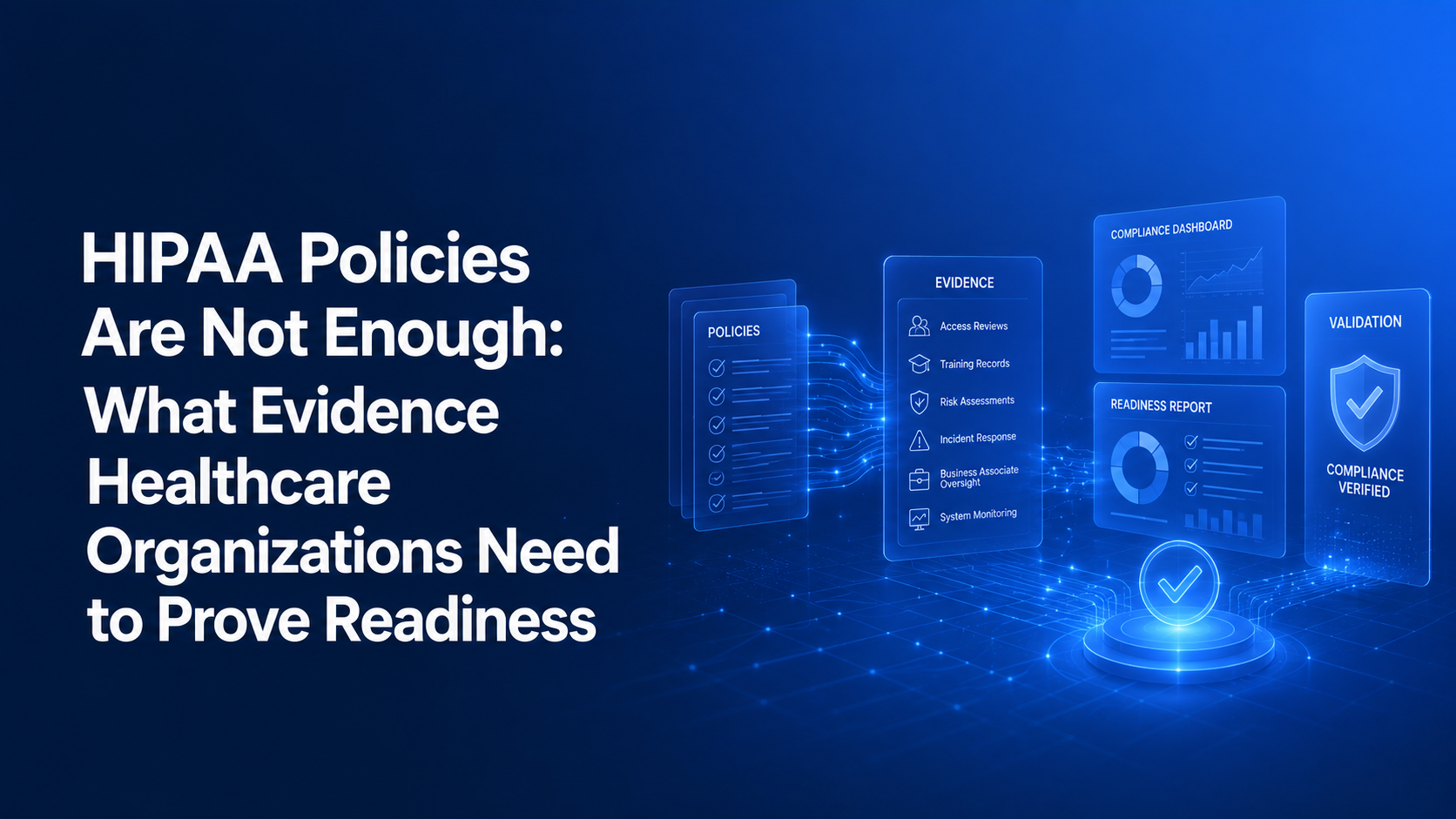
Policies describe intent. Evidence demonstrates execution. Can you prove the policy is being followed? What evidence healthcare orgs need to prove readiness.
Most healthcare organizations have policies.
Security policies. Privacy policies. Acceptable use policies. Incident response policies. Backup policies. Vendor management policies.
Many of these documents are carefully written, reviewed each year, and stored in organized compliance folders. On paper, everything may look complete.
Then an audit request arrives. A cyber insurance questionnaire asks for supporting documentation. A board member wants to know whether controls are working. A vendor review raises new questions. Or a security incident forces the organization to prove what happened, when it happened, and how the team responded.
That is when a different question appears:
Can you prove the policy is being followed?
That distinction matters.
Policies describe intent. Evidence demonstrates execution.
As healthcare cybersecurity expectations continue to evolve, organizations need more than written policies. They need evidence of HIPAA compliance showing that safeguards are operating, risks are being managed, vendors are being reviewed, recovery plans are being tested, and security activities are occurring consistently.
This is also one of the reasons the proposed HIPAA Security Rule updates have gained so much attention. The current HIPAA Security Rule remains in effect today, but the proposed rule points toward a more evidence-driven future, with stronger emphasis on documentation, validation, testing, and accountability. 1
The conversation is moving beyond “We have a policy.”
It is becoming “Show us how you know it is working.”
Both are necessary.
Documentation gives the organization structure. Evidence gives leadership confidence that the structure is being followed.
The stronger the evidence, the easier it becomes to defend the program.
Not in a confrontational way.
In a practical way.
A healthcare organization should be able to demonstrate how it protects ePHI, identify where gaps exist, and outline what it is doing next.
This checklist is not a substitute for legal or compliance advice.
It is a practical starting point for readiness.
HIPAA Policies at a Glance
- HIPAA policies are important, but policies alone do not prove readiness.
- Healthcare organizations need operational evidence showing that safeguards are implemented and functioning.
- HIPAA compliance evidence may include MFA reports, access reviews, risk analysis records, vulnerability scan results, backup testing documentation, vendor assessments, training records, system logs, and remediation records.
- Evidence helps support audits, cyber insurance reviews, executive oversight, regulatory inquiries, and incident response.
- The strongest programs collect evidence continuously, not only when an audit or questionnaire arrives.
- Evidence management is difficult without repeatable processes, managed IT support, cybersecurity monitoring, documentation workflows, and clear ownership.
- A readiness assessment can help healthcare leaders identify which evidence gaps matter most and where to focus in the next 90 days.
What Is HIPAA Compliance Evidence?
HIPAA compliance evidence is documentation that shows safeguards are operating in practice. It may include reports, logs, assessments, test results, review records, training documentation, remediation activity, and other proof that security and compliance activities are occurring. A policy says what should happen. Evidence shows what did happen. For healthcare leaders, that difference is practical, not theoretical. If an auditor, insurer, regulator, executive, or business partner asks how you know a safeguard is working, evidence should help answer the question. HHS explains that the HIPAA Security Rule requires covered entities and business associates to protect electronic protected health information (ePHI) through appropriate administrative, physical, and technical safeguards. 2 Policies support those safeguards, but they are only one part of the picture. Readiness depends on execution.Why Policies Alone Are Not Enough
Policies serve a real purpose. They establish expectations. They define responsibilities. They create consistency. They help teams understand how security and privacy safeguards should operate. But a policy cannot prove that a safeguard is working. Consider a simple example. A healthcare organization may have a policy requiring multi-factor authentication for administrative accounts. That policy does not prove:- MFA is enabled.
- Users are enrolled.
- Exceptions are tracked.
- Privileged accounts are reviewed.
- Access remains appropriate over time.
- Controls are still functioning after system changes.
Documentation vs. Evidence
The easiest way to understand the difference is through comparison.| Documentation | Evidence |
| Describes intent | Demonstrates execution |
| Explains what should happen | Shows what happened |
| Usually policy-focused | Usually activity-focused |
| Often static | Often generated over time |
| Created or reviewed periodically | Collected continuously |
| Supports governance | Supports validation |
| Helps define responsibility | Helps prove accountability |
Why This Matters More Than Ever
Healthcare organizations face pressure from several directions at once.Regulatory Expectations
Regulators often look beyond written policies and evaluate whether organizations can demonstrate implementation of safeguards. HHS risk analysis guidance states that risk analysis is a foundational step, as organizations must understand risks and vulnerabilities before implementing reasonable and appropriate security measures. 3 That creates an evidence requirement in practical terms. If a healthcare organization says it has evaluated risk, it should be able to produce the records that support that statement.Cyber Insurance Requirements
Cyber insurers increasingly ask detailed questions about MFA, backups, endpoint protection, incident response, vulnerability management, training, and recovery capabilities. A “yes” answer is rarely enough. Organizations may need reports, screenshots, policy acknowledgments, test results, or system-generated evidence to support their answers. If documentation is scattered or incomplete, the renewal process can become stressful very quickly.Executive Oversight
Leadership teams want to know whether cybersecurity investments are reducing risk. A policy can describe the intended control. Evidence can show whether that control is active, monitored, tested, and improving. That is the difference between general reassurance and informed decision-making.Operational Resilience
Evidence also helps organizations understand whether they can keep operating during a technology outage or cyber incident. A recovery plan has value. A tested recovery plan creates confidence. This is especially important for healthcare organizations because downtime affects patient care, scheduling, communications, prescriptions, referrals, documentation, and revenue cycle activity. For a deeper look at this connection, see The 72-Hour Recovery Objective: How Healthcare Practices Can Prepare for EHR, Phone, and Network DowntimeWhat Auditors, Regulators, and Assessors Often Want to See
One common misconception is that auditors primarily review policies. Policies are part of the review. They are not the whole review. Healthcare organizations are often asked to demonstrate how policies are implemented and maintained. Common evidence requests may include:- Risk analyses
- Access review documentation
- MFA enrollment reports
- Vulnerability scan results
- Patch management records
- Security awareness training records
- Incident response records
- Vendor assessments
- Backup testing results
- Recovery exercise documentation
- System logs
- Audit trails
- Remediation documentation
- Policy acknowledgments
- Security monitoring reports
Policy vs. Evidence: Practical Examples
| Area | Policy | Evidence |
| MFA | MFA policy | MFA enrollment reports, admin account reviews, exception records |
| Risk analysis | Risk management policy | Risk analysis report, risk register, remediation plan |
| Vendor oversight | Vendor management policy | Vendor assessments, signed BAAs, security questionnaires |
| Backups | Backup and recovery policy | Backup logs, recovery testing records, restoration results |
| Training | Security awareness policy | Completion records, phishing simulation results, acknowledgments |
| Incident response | Incident response plan | Incident logs, tabletop exercise records, corrective actions |
| Vulnerability management | Patch management policy | Scan reports, remediation tickets, patch deployment records |
| Monitoring | Security monitoring policy | Alert reports, investigation notes, escalation records |
The Shift from Compliance Documentation to Compliance Readiness
Many healthcare organizations have historically approached HIPAA as a documentation exercise. Create the policies. Review them annually. Store the files. Update the binder. Check the box. That approach is no longer enough. Healthcare compliance readiness now requires a more proactive approach to security. Organizations increasingly need to demonstrate:- Controls are operating.
- Risks are understood.
- Vendors are evaluated.
- Recovery plans are tested.
- Workforce members are trained.
- Monitoring is active.
- Improvements are tracked.
- Leadership can see progress.
The Question Healthcare Leaders Should Be Asking
Instead of asking, “Do we have a policy?” Healthcare leaders should ask, “What evidence do we have that this control is working?” That one question often reveals the difference between a program that exists on paper and a program that can withstand scrutiny. It also helps prioritize action. If the evidence is missing, outdated, scattered, or difficult to explain, the organization has an opportunity to improve. For many teams, this is where DataTel’s HIPAA Readiness Assessment can help. The assessment gives healthcare organizations a practical way to evaluate readiness across access controls, resilience and recovery, compliance and audit readiness, and governance and risk.What Evidence Should Healthcare Organizations Maintain?
The right evidence depends on your size, systems, risks, vendors, and compliance obligations. Still, most healthcare organizations should be able to produce evidence across several core domains. The goal is not paperwork for its own sake. The goal is operational proof. If an auditor, insurer, regulator, or executive asks how you know a safeguard is working, your evidence should clearly answer that question.Access Control and MFA Evidence
Access control is one of the most important evidence categories because it affects who can reach systems containing ePHI. Organizations should maintain evidence such as:- MFA enrollment reports
- User access reviews
- Administrative account reviews
- Privileged access records
- User provisioning and deprovisioning records
- Termination checklists
- Remote access logs
- Exception documentation
- Risk acceptance records for unsupported systems
Risk Analysis Evidence
Risk analysis is foundational to HIPAA readiness. HHS guidance states that all ePHI created, received, maintained, or transmitted by an organization is subject to the Security Rule, and that organizations must evaluate risks and vulnerabilities in their environments. 3 A stronger evidence set may include:- Risk analysis reports
- Asset inventories
- ePHI data flow documentation
- Threat evaluations
- Vulnerability assessments
- Impact analysis
- Risk ratings
- Risk registers
- Remediation plans
- Risk acceptance records
- Leadership review notes
Vulnerability Management Evidence
Vulnerability management evidence shows that technical weaknesses are being identified, prioritized, and addressed. Useful evidence may include:- Vulnerability scan reports
- Scan schedules
- Asset coverage records
- Severity ratings
- Remediation tickets
- Patch deployment reports
- Exception records
- Retesting results
- Aging reports for unresolved findings
- Executive summaries showing progress
Vendor and Business Associate Evidence
Vendor oversight is often among the weakest areas of evidence in healthcare. Many organizations maintain signed Business Associate Agreements, or BAAs. That is important, but it does not prove vendor safeguards are operating. Vendor evidence may include:- Signed BAAs
- Vendor risk assessments
- Security questionnaires
- Compliance attestations
- Audit reports
- Security certifications
- Incident notification procedures
- Backup and recovery documentation
- Subcontractor information
- Access control evidence
- Periodic vendor review records
- Remediation requests and follow-up notes
Backup, Recovery, and Business Continuity Evidence
Most healthcare organizations have some form of backup or recovery plan. Fewer can prove recovery will work under pressure. That gap matters because recovery is not simply a technical issue. It affects patient care, phones, scheduling, prescriptions, referrals, billing, staff coordination, and clinical decision-making. Recovery evidence may include:- Backup completion reports
- Backup failure reports
- Backup retention records
- Storage location documentation
- Recovery testing results
- Restoration screenshots or logs
- Downtime exercise records
- Recovery time measurements
- Lessons learned reports
- Corrective action plans
- Communication plan testing
- Vendor recovery coordination records
Security Awareness and Workforce Training Evidence
Human behavior remains a major part of cybersecurity risk. Training evidence helps show that workforce members receive appropriate security and privacy education. Examples include:- Training completion records
- Training dates
- Participation rates
- Role-specific training records
- Phishing simulation results
- Remediation training records
- Policy acknowledgments
- Annual review attestations
- New-hire training documentation
Monitoring and Incident Response Evidence
Many organizations have incident response plans. The stronger question is whether they can show monitoring and response activities. Evidence may include:- Security monitoring reports
- Alert summaries
- Investigation notes
- Escalation records
- Incident logs
- Containment documentation
- Tabletop exercise results
- Lessons learned reports
- Corrective action records
- Communication records
- Timeline documentation
Audit Readiness Evidence Checklist
Healthcare organizations preparing for audits, cyber insurance reviews, internal assessments, or vendor due diligence should know whether they can quickly produce evidence in the following areas.| Domain | Evidence to Maintain |
| Governance | Security policies, risk management policies, vendor management policies, incident response plans |
| Risk management | Risk analyses, risk registers, remediation plans, vulnerability reports |
| Access controls | MFA reports, access reviews, provisioning records, termination records |
| Asset visibility | Asset inventories, network maps, ePHI data flow documentation |
| Vendor oversight | BAAs, vendor assessments, questionnaires, security reviews |
| Recovery and resilience | Backup reports, recovery testing results, downtime exercises, recovery metrics |
| Workforce training | Training records, phishing results, policy acknowledgments |
| Monitoring and response | Security monitoring reports, incident logs, investigation notes, corrective action records |
| Remediation | Assigned owners, due dates, completion records, retesting results |
| Executive oversight | Dashboards, summary reports, risk acceptance decisions, board updates |
Why Evidence Management Is Difficult
Evidence sounds simple until teams try to collect it. In many healthcare organizations, evidence lives in different places:- IT systems
- Security platforms
- HR files
- Vendor portals
- Email threads
- Ticketing systems
- Backup systems
- Cloud dashboards
- Compliance folders
- Shared drives
- Spreadsheets
- Meeting notes
The Goal Is Not More Paperwork
One of the biggest mistakes organizations make is assuming this topic is about creating more documents. It is not. The objective is operational visibility. Evidence helps answer practical questions:- Are safeguards functioning?
- Are risks being reduced?
- Are vendors being evaluated?
- Can systems be recovered?
- Is training effective?
- Are incidents being managed?
- Are remediation efforts moving forward?
- Can leadership see the risks clearly?
The Five Biggest Mistakes Healthcare Organizations Make With Compliance Evidence
Most healthcare organizations understand that documentation matters. The challenge is determining whether that documentation demonstrates readiness.Mistake 1: Assuming Policies Prove Compliance
Policies establish expectations. They do not prove those expectations are being met. A policy may require MFA. Evidence demonstrates MFA is enabled. A policy may require annual training. Evidence demonstrates that workforce members completed it. A policy may require backups. Evidence demonstrates backups occurred and recovery was tested. Policies are the starting point. Evidence shows execution.Mistake 2: Collecting Evidence Only Before Audits
Many organizations become highly organized right before an audit. Reports are gathered. Screenshots are collected. Files are renamed. Documentation is assembled. That approach creates pressure because evidence collection becomes reactive. Organizations that collect evidence continuously often experience faster audit responses, less stress, better visibility, and stronger cybersecurity maturity.Mistake 3: Focusing Only on Technical Controls
Technical evidence matters, but cybersecurity risk extends beyond technology. Many organizations can produce vulnerability reports and patch records, but struggle to produce vendor reviews, recovery test results, training records, risk acceptance documentation, or tabletop exercise notes. A mature readiness program evaluates people, processes, technology, vendors, and operations.Mistake 4: Treating Evidence as a Compliance Exercise
Evidence should do more than satisfy auditors. It should help leaders make better decisions. Recovery testing reports show whether the organization can operate during downtime. Access reviews reveal privilege risks. Vendor assessments identify third-party exposure. Risk registers show where investment may be needed. The most useful evidence improves the program.Mistake 5: Failing to Connect Evidence to Risk
Not all findings carry the same weight. A long report may look thorough, but it is only useful if someone understands what it means. Evidence becomes most valuable when it helps answer:- Which risks matter most?
- Which systems are critical?
- Which vendors create exposure?
- Which improvements should happen first?
- Which decisions require leadership approval?
What Healthcare Leaders Should Do in the Next 90 Days
Healthcare organizations do not need to overhaul their entire compliance program overnight. A structured 90-day plan is usually more effective.Days 1 to 30: Inventory Existing Evidence
Start by identifying what already exists. Ask:- Can we produce MFA reports?
- Do we have current access reviews?
- When was our last risk analysis completed?
- Do we maintain a risk register?
- Can we find vendor assessments quickly?
- Have we documented recovery testing?
- Are training records centralized?
- Do we have evidence of vulnerability remediation?
- Can leadership see the current state clearly?
Days 31 to 60: Identify Gaps
Next, compare available evidence against the areas that matter most. Common gaps include:- Recovery testing documentation
- Vendor oversight records
- Access review evidence
- Incident response exercise results
- Remediation tracking
- Asset inventories
- Network maps
- Audit log reviews
- Executive reporting
Days 61 to 90: Build Continuous Collection Processes
The strongest programs collect evidence as part of normal operations. Recommended actions include:- Centralizing documentation
- Automating reports where possible
- Assigning evidence owners
- Scheduling periodic access reviews
- Tracking remediation tasks
- Documenting recovery tests
- Reviewing vendors on a recurring schedule
- Creating executive summaries
- Updating risk registers after major changes
How DataTel Helps Healthcare Organizations Build Defensible Readiness
Healthcare leaders do not need more vague advice. They need a practical way to understand what is working, what is missing, and what should happen first. DataTel helps healthcare organizations evaluate readiness across four core areas.Compliance and Audit Readiness
This includes:- Documentation maturity
- Evidence collection processes
- Audit preparedness
- Reporting gaps
- Security documentation review
Access Controls
This includes:- MFA deployment
- Identity governance
- Privileged access management
- User lifecycle management
- Access review processes
Resilience and Recovery
This includes:- Backup validation
- Recovery testing
- Downtime preparedness
- Operational continuity
- Recovery documentation
Governance and Risk
This includes:- Risk analysis maturity
- Vendor oversight
- Remediation planning
- Executive reporting
- Strategic prioritization
Take DataTel’s Free HIPAA Readiness Assessment
Many healthcare organizations know they have policies. The harder question is whether they can demonstrate readiness. Take DataTel’s free HIPAA Readiness Assessment to evaluate your organization across:- Compliance and audit readiness
- Access controls
- Resilience and recovery
- Governance and risk